 English
  French
This article is intended for the more experienced and will require some basic pattern-making knowledge.
This article will cover various concepts for identifying whether adaptation is necessary. the position of the crotch/inseam.
This is a very important concept for me. It is important to know and understand. It will allow you to adjust all clothes such as: panties, swimming costumes, bodysuits, leggings, shorts, ...
If there is one thing to remember, it is what follows.
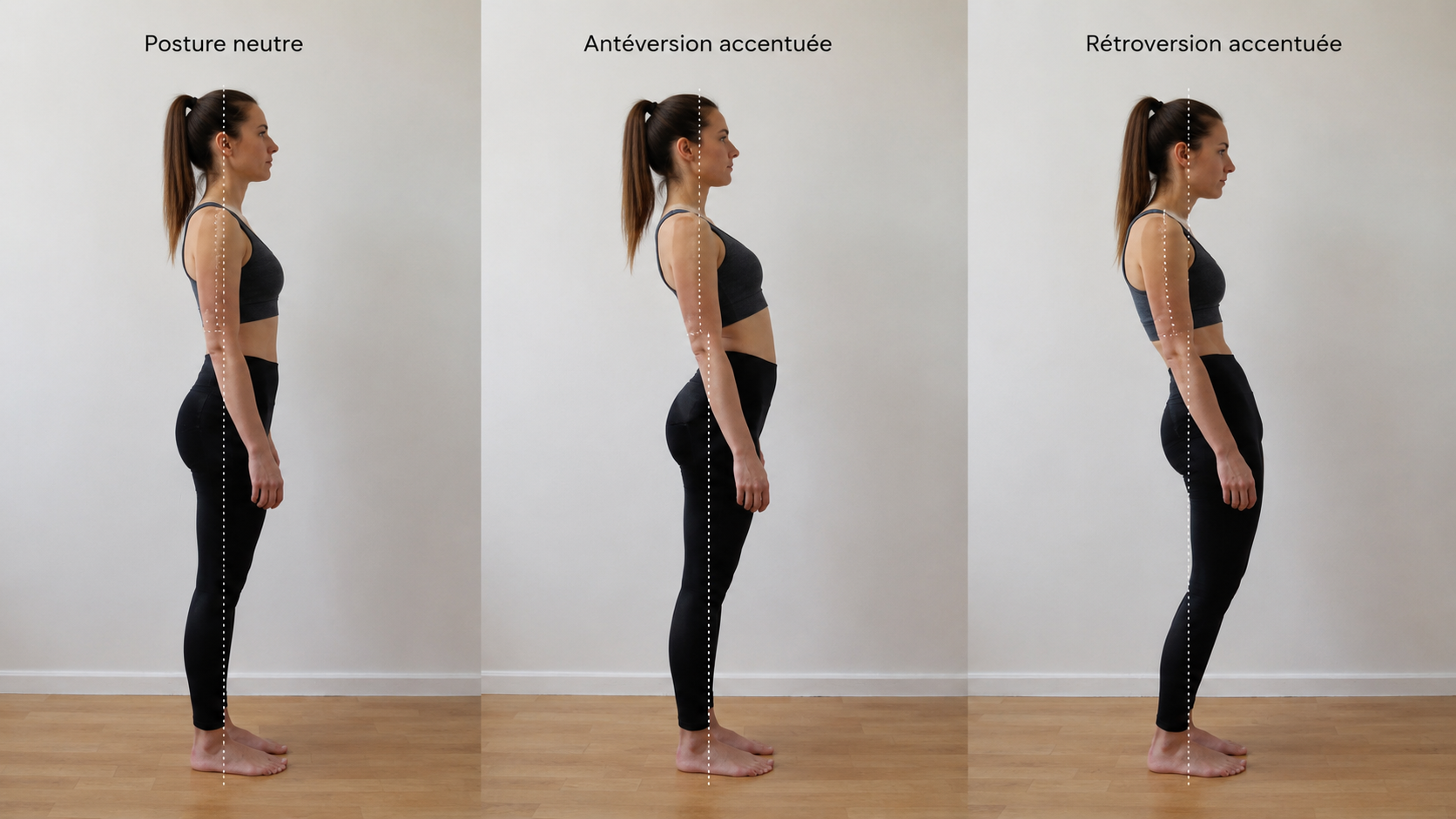
Its position is linked to your morphology: retroversion or anteversion of the pelvis.
examples:
- anteversion -> tilting of the anterior pelvis - arched back
- retroversion -> tilting of the posterior pelvis - back not arched
*la notion de dos cambré ne tient pas compte de la forme des fesses (fesses plates, volumineuses, …) qui impactera également le bien allé d’une culotte, .. mais là c’est la forme de la culotte ou maillot qui impactera principalement le porté du vêtement. Ce thème donnera lieu à un autre article.
How to quantify anteversion and retroversion?
The most complex thing is to determine how much retroversion or anteversion there is.
The "simplest" version is to estimate the angle formed by a line passing through the tip of the illiac bone and the symphysis pubis, as shown below.
To do this, it is essential to position yourself correctly in profile. Do not hesitate to touch in order to identify the position of the bony points (it is important to base yourself on the position of the pelvis and not the stomach).

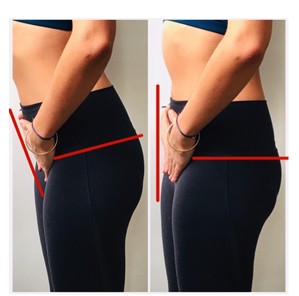
In retroversion, the angle can be between 0 and 10 degrees.
In anteversion, the angle may be between 0 and 22 degrees.
Il peut exister des angles plus importants mais ce sont des cas que l’on rencontre pour d’autres éthnies (profils non européens)
How do you modify a pattern according to the degree of inclination of the pelvis?
L’exemple ci-dessous est valable pour une culotte ou un bikini ou un body et maillot 1 pièce
I move the inflection point of the crotch 2 cm for every 15 degrees of inclination and so on. The same applies to the forward and backward tilt of the pelvis.


Just think:
- anteversion -> moving the bottom of the trousers towards the front (reduces the length of the front and increases the back)
- retroversion -> moving the bottom of the trousers towards the back (reduces the back length and increases the front).
You will then have to retrace the area of the bottom of the panties, taking care to respect the width of the gusset at the narrowest point (point of inflection between the front and the back) but also not to reduce or increase the width of the bottom of the panties at its extremities.
And then? But only for knickers or a two-piece swimsuit!
-Sur le devant : ouvrir (ou fermer pour l’inclinaison postérieure) le devant de la culotte / ou maillot de bain — ° ouvrir (ou fermer) de respectivement 5° de chaque côté.
-Sur le dos : vous pouvez élargir légèrement (ou réduire) la largeur de la culotte au niveau des fesses. C’est important notemment dans le cas d’une inclinaison antérieure , l’inclinaison du bassin entraine le déplacement des faces latérales des fesses vers l’extérieure.
Conclusion
The most difficult thing about the crotch is often to determine how the increase/decrease will be distributed between the vertical correction and the position of the inflection point. But when you look closely, its position is essential.
If you need to adjust the pattern for this reason, adjust the position of the inflection point first and only then the vertical adjustment of the crotch.